
Roland TD316 vs Alesis Strata Core: E-Kit Showdown

Expert Tested

I've personally tested every product featured in this article to ensure quality and performance you can trust. See the video for full results and insights. Learn more about my review process.

Learn more about my review process.
Roland TD316 Vs Alesis Strata Core

Right now, if you’ve got about $2000 to spend on an electronic drum kit, there are two kits that stand out above everything else.

The Roland TD-316 and the Alesis Strata Core. I’ve reviewed both of these kits in depth and played through every preset kit on both modules. And while they’re both fantastic… They each have some different strengths.

So in this article, I want to put them head-to-head, looking at things like sound quality, pad feel, rack design and setup, module features, and overall value. By the end of this article, you should have a really clear idea of which kit is the better choice for you.

Overview

Before we dive into the comparisons, let’s take a quick look at what each kit is all about.

The Roland TD-316 really leans into what Roland has always done well — solid triggering, great sounds, and a really refined playing experience.

They’ve been making electronic drums for decades now, and that experience definitely shows in things like the pad feel and overall build quality.

The Alesis Strata Core represents the newer generation of Alesis kits. Alesis has really been stepping things up in recent years, and the Strata lineup is a great example of that.

The Core offers modern sounds, powerful module features, and a very flexible hardware setup.

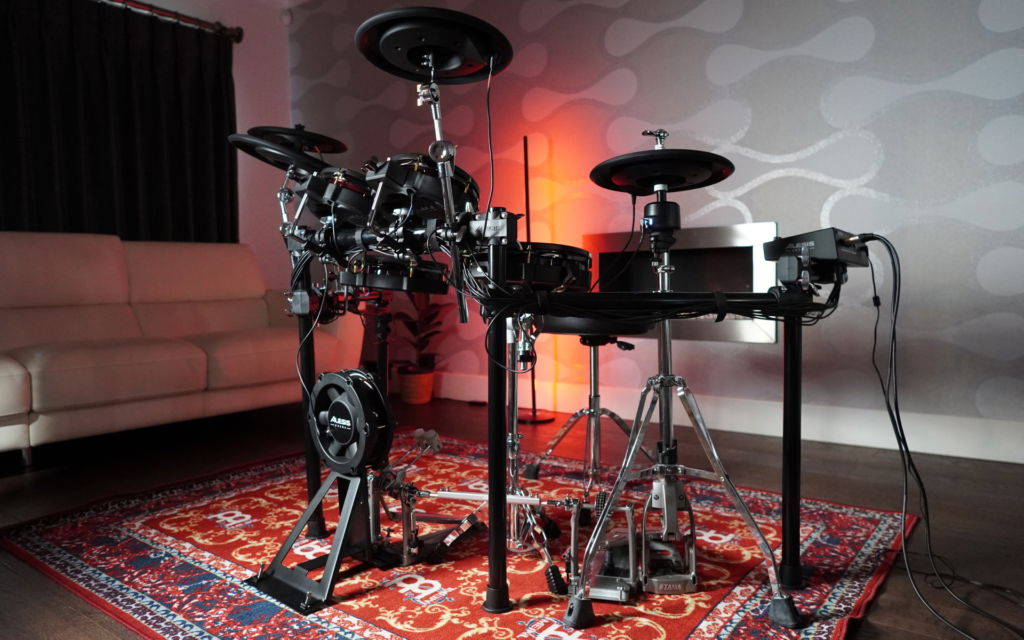
Alesis Strata Core Behind

And I’ve actually reviewed all three kits in the Strata line — the Prime, Core, and Club — and they’ve all been really consistent and enjoyable to play.

Rack Design & Setup

Let’s start with something practical – setting the kits up.

Both kits were pretty straightforward to assemble, and I didn’t run into any issues putting either of them together. The TD316 was slightly easier as it had clamps already on the rack.

The Roland rack is clean and sturdy, and the overall quality is great. Even small details like the knobs and fittings feel refined, which is something Roland has always done well. However, compared to the Strata Core, the Roland rack is a bit more limited when it comes to adjustability.

The rack tom arms are mounted in fixed positions on the rack, so you can’t slide them along the bar like you can on the Strata Core. You can still adjust the L-rod height and angle, but the actual mounts stay in place.

The cymbal arms are also a straight pole design, which works perfectly fine, but again they’re a little more limited when it comes to positioning.

The snare mounts directly to the rack using a large ball-and-socket mount, which actually works really well. I had no issues getting that into a comfortable position.

By comparison, the Strata Core is definitely more flexible.

You get boom arms for the cymbals, which gives you more freedom when positioning them, and the rack tom mounts can slide along the rack bar and rotate, giving you quite a lot of control over your tom placement.

The snare also mounts on an included snare stand, which gives you even more flexibility when setting up the kit.

Overall, the Strata Core gives you a bit more freedom with positioning. But to be fair, I was still able to get the Roland set up comfortably without any issues. For most people, the Roland setup will honestly be just fine.

Alesis Strata Core toms

Pads & Playing Feel

In terms of pad sizes, the two kits are actually very similar.

On the Strata Core, you get: a 12-inch dual-zone snare, two 8-inch rack toms, and a 10-inch floor tom (all dual-zone). These all feel great and I tightened them up a bit to get a nicer response.

The Roland TD-316 has the same general layout, with a 12 inch dual-zone snare, two 8-inch rack toms, and a 10 inch floor tom (again all dual-zone). The pads themselves do feel a little bit more sleek and professional than on the Core.

The snare pad especially is a standout feature. It has a 12-inch playing surface with a heavier design and chrome metal rim, which gives it a really premium feel.

It also uses three internal sensors, which allows for extremely accurate and refined triggering. This snare pad is honestly very impressive, and it’s one of the highlights of the TD-316.

Kick Towers

Both kits include solid kick towers. The Strata Core uses an 8-inch mesh pad, while the Roland uses the KD-10 which is a 5-inch mesh pad.

Alesis Strata Core kick tower

Both feel good to play and handle double pedal playing without any issues.

The only small thing I noticed is that both towers crept forward slightly, so I had to use velcro to secure them down.

On the Roland KD-10, I also noticed some slight denting in the foam where the beater hits, which apparently is fairly common and doesn’t affect triggering.

Hi-Hat & Cymbals

The cymbal setup on both kits is very similar, with two 12 inch crashes and a 14 inch ride, but the Strata Core hi hat is 12 inches instead of the Roland’s which is 10 inch.

I must say, the Roland VH-10 hi-hat paired with the V31 module is excellent.

It’s extremely sharp and responsive, and the way it responds just feels very natural. So when it comes to hi-hat realism, Roland definitely takes the edge here.

However, the Strata Core crashes and ride are great- they are triple-zone with different sounds on the bell, bow, and edge, and they’re also fully 360-degree playable.

They swing naturally and respond well to dynamics, and I found them quicker to react when choking them.

The Roland cymbals feature an all-new design, and I did like them also. The crashes are dual-zone, while the ride is triple-zone.

Sound Engine & Preset Kits

Now let’s talk about sound quality, because this is a huge part of the comparison. 

Both kits have a huge number of preset kits. The Roland V31 module includes 70 kits, while the Strata Core module includes 75.

I’ve gone through all the kits on both drum modules, and made videos showcasing all of them.

On the Roland, the V31 module has a great selection of sounds. My personal favourite is Studio A, which is kit number one, and there are definitely some great usable sounds throughout. However, the last 20 or so kits become a bit more experimental.

With the Strata Core, I found the overall selection to be a little more consistently usable. Honestly the Alesis Strata Core surprised me quite a bit. Every time I was scrolling through the kits I kept thinking: “that sounds really good.”

The Core module is essentially just a smaller version of the flagship Strata Prime module. It has the exact same sounds and customization as the Prime. The only differences are a slightly smaller screen and fewer outputs, but the sound engine and functionality are identical. The sounds are top-of-the-range.

On the Roland side, the V31 module shares the same sound engine, motherboard, CPU, and core technology as the V71. So while it’s not quite the full thing, you’re still getting a lot of Roland’s higher-end tech at a much lower price point.

Module Editing & Features

Both modules are extremely powerful when it comes to sound editing.

You can adjust things like: Tuning, ambience, EQ, compression, effects, adding stacks, and of course create your own custom kits.

Honestly, both systems go far deeper than I would personally ever need. In terms of usability though, I’d say I preferred working with the Core module.

Roland V31 Module

The touchscreen interface is larger, clearer, and feels very modern, and navigating it is very intuitive. That said, I think the Roland was a little quicker to turn on and is slightly more responsive.

In terms of other features, both modules are pretty similar. They are both WiFi enabled so you can get firmware updates over the cloud, and of course have bluetooth connectivity, as well as standard outputs and inputs, USB connectivity, and trigger expansion for an extra tom and cymbal pad if you like.

Alesis Strata Core Module

Final Verdict

So which one would I actually choose? Honestly… this is a really close call.

Both of these kits are fantastic for the money, and I’d genuinely rate them both as S-tier electronic drum kits under $2000. If we break it down:

Roland takes the edge for:

  • pad quality
  • hi-hat and snare realism
  • overall refinement

But the Strata Core takes the edge in a few key areas:

  • drum sounds overall
  • the touchscreen module
  • rack flexibility and positioning

So if I absolutely had to choose one based purely on my experience- I’d probably give the slight edge to the Strata Core. But honestly, we’re splitting hairs here.

Roland’s build quality and reliability are legendary, and the TD-316 is also an incredible kit.

So whichever one you choose, you’re getting one of the best electronic drum kits currently available at this price.

Scroll to Top