


I review products independently and only recommend products I would use myself. If you purchase through a link, I may earn an affiliate commission. Learn more.
Including a hi-hat microphone in a recording setup will make a big difference to the overall sound captured of a drum set. It will help you to achieve the most detailed and complete sound possible for studio and live settings.
I’ve personally tested eight of the top hi-hat microphones in this head to head comparison, and each of these mics brings something a little different to the table in terms of tone, response, price, and versatility.
Keeping things fair, I maintained the same mic placement, tuning, and gain levels across the board, capturing each take in a way that highlights both open and closed hi-hat sounds. The aim was to give you an honest sound comparison for each mic without the influence of additional processing.



In a Rush' Round-Up
| Image | Recommended ProductsProduct | Features | Compare Price |
|---|---|---|---|

|
|
CHECK LATEST PRICE ALT CHECK LATEST PRICE | |

|
|
CHECK LATEST PRICE ALT CHECK LATEST PRICE | |

|
|
CHECK LATEST PRICE ALT CHECK LATEST PRICE | |

|
|
CHECK LATEST PRICE ALT CHECK LATEST PRICE | |

|
|
CHECK LATEST PRICE ALT CHECK LATEST PRICE | |

|
|
CHECK LATEST PRICE ALT CHECK LATEST PRICE | |

|
|
CHECK LATEST PRICE ALT CHECK LATEST PRICE | |

|
|
CHECK LATEST PRICE ALT CHECK LATEST PRICE |
How I Tested and Selected the Best Hi-Hat Mics
With plenty of experience tracking drums for various bands and recording studios, I’ve used numerous different hi-hat mics. I used that experience when choosing mics for this comparison video.
When testing each mic, I first looked at sound quality and clarity. Hi-hats often disappear in a mix, so I checked to see how each mic boosted the sound of the hats when I played them.
I also looked at positional sensitivity. I placed the mic in various positions around the hats and tested how the sound was affected.
After that, I looked at build quality and features. I inspected the casing of each mic to see how durable it would be. I then looked at the body features and what they offered. This included things like dB switches and high pass filters.
Finally, I inspected the quality of the case that came with each mic. This is what keeps them safe when you’re not using them, so it was an important part to consider.
Hi Hat Mics Reviews
Neumann KM 184 Condenser Microphone

Neumann KM 184 Condenser Microphone Review
The Neumann KM 184 is one of the smallest microphones on this list. However, it’s one of the best overhead microphones I’ve tried in recent years, as it just offers so much in its small package.
I’m constantly blown away by how much clarity this little mic offers. It does a fantastic job of accurately reflecting how your hi-hats sound in the room.
The boosted clarity also gives you a great platform to mix from. With a fairly flat response, you can take your hi-hat sounds wherever you want them to go. So, it’s quite a versatile option, especially compared to something like the Rode M3 that works better for brighter cymbals.
This also means that it works very well with other instruments. If you plan on purchasing a mic to use on your hi-hats but also want more variety with how you use it, this one is a perfect choice.
I highly recommend this mic to any drummer who wants something remarkably rich and clear.
The only drawback is that it’s quite pricey compared to several other high-quality options that drummers regularly use. If you’re happy to spend the money, I’d say it’s more than worth it.
However, you could pick any of the other mics I’ve listed and still get fantastic results. You just won’t get the unique blend of a small physical design and powerful sound recreation that you’ll get from this KM 184.
Key Features:
- Small-diaphragm design
- Cardioid pickup pattern
- 20 Hz – 20 kHz frequency range
Pros
- Produces a much bigger sound than you’d expect from such a small microphone
- Offers an extreme level of clarity that makes mixing your hi-hats quite easy
- Exceptional level of bleed rejection when set up on your drum kit
Cons
- Very expensive compared to other popular hi-hat mic options that drummers tend to love
Audio-Technica AT4041 Condenser Microphone

Audio-Technica AT4041 Condenser Microphone Review
With a distinguished appearance, the AT4041 looks like it should cost twice the amount of its modest price tag. It also has a brilliantly clear and crisp tone and is ideal for capturing open and closed hi-hats.
The volume of a hi-hat can vary depending on several factors. When totally closed, the sound is less resonant and tighter than the ringy, somewhat chaotic sound of a fully opened hi-hat.
The Audio-Technica AT4041 small condenser mic can handle all kinds of hi-hat sounds. If you’re a rock drummer who doesn’t hold back, this mic’s 121dB max SPL handling will be useful.
Drumming styles like funk or R&B rely heavily on the sound of the hi-hat, and this mic has all of the required qualities to translate the drummer’s feel into a recording or live sound setup.
I love how natural this microphone makes your hi-hats sound, and it’s thanks to the extensive frequency response and transformerless design.
This is enhanced by the addition of an element back plate, which maintains a fixed charge. This component has been aged to stabilize energy optimally, resulting in a more consistent performance.
It can also be used for a range of other instruments, making it great value for the price. You can place it in front of an electric guitar amp or use it to capture the details of a piano.
Pros
- Rich sounding with a precise pickup pattern
- Can handle very loud hi-hats
- Excellent build quality and durability
Cons
- No negatives we can think of
Audix ADX51 Condenser Microphone
Audix ADX51 Condenser Microphone Review
Unlike some high-end mics that need a lot of fiddling, this one sounds great right off the bat – it’s bright and detailed, with just the right amount of treble to make hi-hats cut through.
The ADX51 has a small-diaphragm condenser build, which is perfect for capturing those crisp, sharp details in hi-hats. It’s a bit unique because while it’s originally designed for overheads, drummers have realized it works incredibly well on hi-hats too. You get a natural boost in the high frequencies, so the hats sound articulate and clear without coming off harsh or distorted.
Sure, it doesn’t pick up much low-end – but that’s actually a plus here since you don’t need those lower frequencies muddying up the mix. In fact, that bright sound makes it a lot more practical for hi-hat use compared to other mics in the same price range, which might sound too thin or demand way more tweaking.
For anyone serious about their hi-hat tone and looking for a straightforward, mid-range option, the Audix ADX51 is definitely worth considering. It’s a solid choice if you want pro-level sound without spending a fortune on a higher-end model that could be overkill.
Pros
- Excellent tight high-end sounds, which makes the microphone perfect for effective hi-hat sounds in a mix
- Pristine detail, no matter where you position it
- Rugged and reliable
- Great mid range option
Cons
- Clip for mic can be stiff
Shure SM-81LC Cardioid Condenser Microphone

Shure SM-81LC Cardioid Condenser Microphone Review
The Shure SM81-LC Condenser Microphone is an excellent sounding microphone that represents the gold standard in acoustic recording. It has a wide frequency range and beautifully detailed sound reproduction.
I’ve found this to be an extremely popular choice amongst engineers and drummers because it has a superb frequency response and a smooth directional pickup pattern.
This versatile microphone is also suitable for overheads as well as for use on all acoustic instruments.
This hi-hat mic features a low inherent noise and high overdrive protection, enabling it to deliver consistent distortion-free recordings even at high sound pressures.
Condenser microphones are not known to be the most durable pieces of equipment, but this mic is indeed robust and durable.
Another excellent feature this microphone has is a selectable three-step low-frequency response, with a choice of flat, 6 or 18 dB roll-off. This allows greater flexibility when recording and makes it a perfect choice for working with drums.
Overall the Shure SM81 captures shimmering high frequencies with clarity, and this makes it perfect for recording the nuances of hi-hats and cymbals. It also has very low noise and it offers superb value for money.
Pros
- Low inherent noise and a high overdrive protection
- Industry standard mic with a smooth directional pattern
- Excellent for capturing hi hats and cymbal overheads
Cons
- Very few negatives, especially for the price point
Rode M3 Small Diaphragm Condenser Microphone

Rode M3 Small Diaphragm Condenser Microphone Review
The Rode M3 Condenser Microphone offers excellent value and is highly versatile for hi-hats and cymbals. Each Rode M3 microphone is designed and made in Australia to a high standard and includes an industry-leading 10-year warranty.
This microphone delivers crystal clear mids and high-end frequencies, making it perfect for cymbals and overheads.
When using this mic, I love how it captures subtle tones and accentuates differences in how I play the hi-hats. The sounds are balanced and not too sharp.
This microphone delivers professional results at an affordable price, and it is very robust and well-constructed. It is a substantial piece of kit and it feels weighty due to its rock solid build quality.
The Rode M3 performs very well both in the studio and on stage. It’s a true workhorse that sounds great for all recording applications. It performs exceedingly well, on par with microphones that are far more expensive.
Pros
- Very high quality build construction
- On par with microphones that far exceed this price point
- Industry-leading 10 year warranty
Cons
- Position switch is a little bit tricky to use
AKG P170 Small Diaphragm Condenser Microphone

AKG P170 Small Diaphragm Condenser Microphone Review
The AKG P170 is a small yet rugged and robust microphone- perfect for drum overheads and hi-hats. It’s a well-built and versatile microphone that makes it suitable for all acoustic instruments, such as acoustic guitars.
This microphone features a lightweight half-inch true condenser transducer diaphragm that delivers great clarity and transient response.
I find this microphone to have very low noise and it does an excellent job at rejecting sound away from its directional pattern.
This microphone offers great value for money, and it’ll be sure to deliver professional results, no matter whether it is used in the studio or on stage.
AKG’s perception line consists of affordable but professional quality microphones built to last and are ideal for all manners of sound recording. This versatile mic has a balanced, clean sound that is perfect for hi-hats, and it’s an excellent investment for your studio toolkit.
Pros
- Reacts well to fast transients at high sound pressure levels
- High quality, dynamic sounds with a smooth directional pattern
- Rugged, durable, and excellent value for money
Cons
- Very few negatives for the price
Shure SM57 Condenser Microphone

Shure SM57 Condenser Microphone Review
The Shure SM57 is just as legendary on hi-hats as it is on snare drums and guitar amps—this mic truly excels in versatility. While it’s known for being the ultimate workhorse in the studio and on stage, its rugged design and cardioid polar pattern make it an unexpectedly solid option for hi-hat miking. You’ll get that bright, focused sound the SM57 is famous for, with great off-axis rejection, meaning bleed from other drums is kept well under control.
What’s great about the SM57 is its natural high-end boost around 4 kHz, which brings out the crispness in your hi-hats without adding harshness. It’s not a delicate condenser, so it may not capture every nuance of softer jazz or intricate textures, but its punchy, clear response suits rock, pop, and even some acoustic setups well. With close-miking, it delivers that tight, bright sound without distorting, thanks to its ability to handle high SPLs.
The SM57 is tough as nails, built to withstand years of use, and perfect for players who need gear that’ll hold up over time.
Pros
- Excellent sounding microphone especially for the price
- Neutral sounding, noise-free transmission
- Extremely versatile mic
Cons
- Sound is more projected on the mid high frequencies
Shure SM7B Dynamic Microphone

Shure SM7B Dynamic Microphone Review
The Shure SM7B is a unique choice for miking hi-hats, offering a distinct sound that stands out in its own way. Its pretty well known for its ability to reject unwanted noise, and it excels in environments with a lot of bleed or background noise. While it doesn’t offer the bright, high-end sparkle you’d get from a condenser mic, it brings a more rounded, slightly muted tone to the table that some drummers may prefer for its warmth and character.
The SM7B is not the cleanest mic, but it shines with its rugged build and versatility. Whether you’re recording in the studio or performing live, its durability and ability to handle high SPLs without distortion make it a solid option for drummers looking for something different.
If you’re after a mic that delivers a unique, full-bodied sound with a bit more grit, the SM7B is worth considering for your hi-hat setup.
Pros
- Great for rock and aggressive Genres
- Solid background noise rejection
- Really well built and robust
Cons
- Some drummers may prefer a smaller mic for their hi hat
Hi-Hat Microphone Buyer’s Guide
While you won’t find hi-hat mics in most microphone packs, they’re a vital part of any professional live or recording setup. A good hi-hat mic will allow your hi-hat to be distinctly heard within a mix.
The mic is often placed near the top hi-hat, but some drummers and engineers like to place it underneath the bottom hat to stop the rest of the kit sound from bleeding into the mic.
If you’re looking to buy a full microphone setup, it’s better to buy the other drum mics before your hi-hat mic. However, the hi-hat mic will add a lot of clarity to your hi-hat sound as opposed to your overhead mics being the only sources that pick the hi-hats up.
The great thing about condenser mics is that you can use them interchangeably as overheads or hi-hat mics.
What to Look for in the Best Hi-Hat Mics
Frequency Response
Frequency response refers to the range of frequencies that a microphone picks up. When using a mic to pick up a whole drum kit, it’s important to have a wide frequency response due to all the different sizes and tones.
With hi-hats, it’s okay, and sometimes better, to have a mic that’s frequency response leans more toward mid and high frequencies.
All the mics listed above have frequency response ranges between 40 and 20 000 Hz, making them perfect options for hi-hat mics.
You’ll usually find ranges like this with condenser mics as opposed to dynamic ones. Condensers are typically more expensive for this and many other reasons.
Sound Quality
Lower priced microphones sound quite good most of the time, but it takes a lot more effort in the post-production process to get them to that place. You’ll need to do extensive mixing to get a studio-level sound from your hi-hats.
The more expensive microphones are a lot easier to work with. You get an amazing sound as soon as you plug them in, making them a better option to go with if you’re not willing to sit and EQ.
As the price of a mic goes up, the better it’s base sound gets.
Durability
The durability of a microphone is determined by its casing. A thicker and sturdier microphone casing lasts a lot longer. You’ll find that higher-priced microphones are always built better, and they’re the types of microphones that can be used for decades.
Many inexpensive microphones tend to sound great when used for recording or live playing, but they don’t last as many years. Their casing either wears out, or their internal wiring goes awry.
So, it’s normally better to invest a bit more into a high-quality microphone that is built to last.
Pickup Pattern
Omnidirectional and cardioid are your two main types of pickup patterns with microphones. When it comes to hi-hat mics, it’s best to look for cardioid mics.
A cardioid mic does well to reject unwanted sounds coming from the sides, so a cardioid mic placed near a hi-hat won’t pick up the sound coming from your snare drum.
You can place a cardioid mic very close to the hi-hats and still get the full extent of tone that your hats have.
Cardioid mics range in prices, with some having budget prices and others having more professional price points. A pickup pattern is one of the features that doesn’t heavily affect the cost of a microphone.
Size
The size of a microphone affects how comfortably you can place it around your hi-hats. If you have a large space to place your drum kit in, this won’t be a big deciding factor.
It’s good to get a smaller hi-hat mic if you plan on using it for live gigs. Just know that smaller mics with top-tier sound reproduction tend to be more expensive.
How to Position a Hi-Hat Mic
When positioning a hi-hat mic, it’s important to consider the following:
- The distance of the mic from the hi-hats
- The angle of the mic towards the hi-hats
- The height of the mic from the hi-hat cymbals
Ideally, you want to place the hi-hat mic close to the hi-hats so it can capture a tight and focused sound.
I’d suggest placing the hi-hat mic about 4-5 inches above the top hi-hat cymbal, pointing towards the edge of the cymbal.
You can see how the hi-hat mic is positioned in one of my most recent recording sessions in the image below.
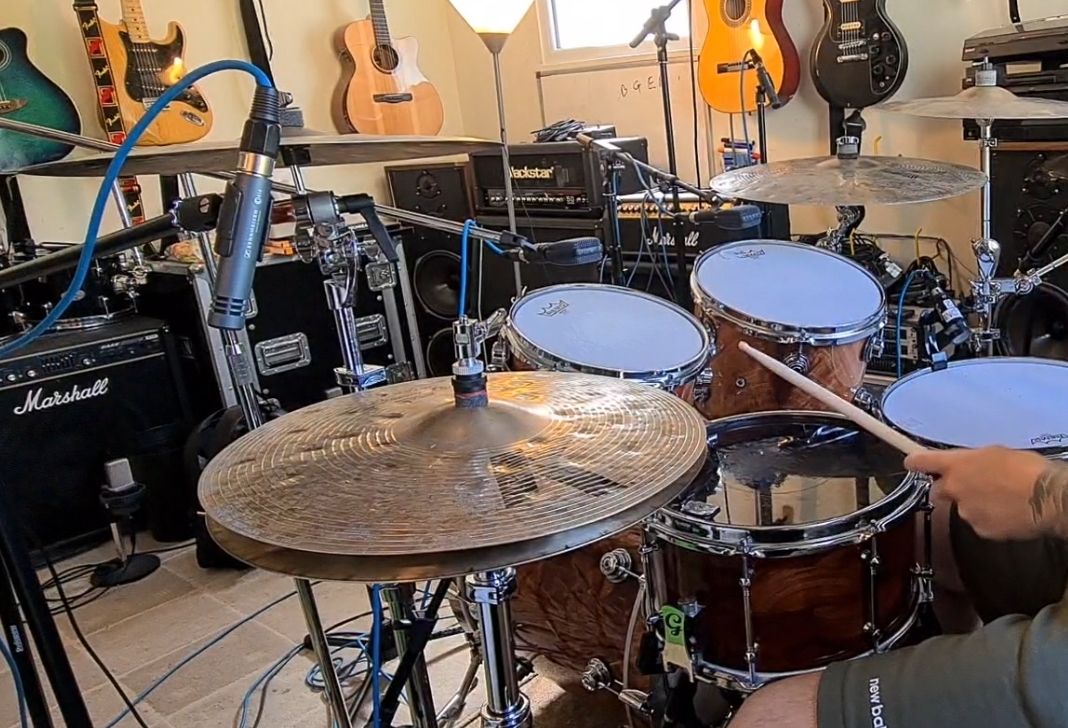
Positioning the mic too far away from the hi-hat will result in the mic picking up more ambiance from the room and potentially picking up bleed from other parts of the drum set.
Therefore, it’s best to position the mic fairly close to the hi-hats. Most drummers and studio engineers like to place the mic above the top hi-hat cymbal as opposed to underneath the bottom hi-hat cymbal.
Just ensure there is enough room to play the hi-hats with your drumsticks and for the hi-hats to open up and down without accidentally striking the microphone.
Experiment with different positions and angles until you find the sound you are looking for.
Hi-Hat Mic FAQs
Are Dynamic or Condenser Microphones Better for Hi-Hats?
Condenser mics are ideal for hi-hats due to their larger frequency ranges. They capture more of the nuances from your hats.
However, you can get away with using a dynamic microphone in certain settings. You just won’t get the same scope of tone as you would with a condenser.
How Much Should You Spend on a Hi-Hat Mic?
Microphones vary drastically in price. The more money you spend, the better the sound quality will be, with more desirable qualities and characteristics. It will also be more durable, causing it to last longer.
You can spend a lot more on a luxury microphone for your hi-hats, but I wouldn’t recommend it for anyone who isn’t a professional studio producer or live sound engineer.
Should You Use More Than One Hi-Hat Mic?
You may find a professional recording studio having two hi-hat mics to get the fullest possible sound from the top and bottom hats, but you can get a perfectly good hi-hat sound with a single mic.
I’d suggest sticking to using only one hi-hat mic and investing all your available money into that.